“Mister, you may conquer the air, but the birds will lose their wonder and the clouds will smell of gasoline” – Inherit the Wind: Act II, scene 3
Delegating Work
Nostalgia is an incredible thing. Recently I took a trip back to the town where I grew up and just drove around, soaking it all in. Memories flooded back and landmarks lit up the synapses in my brain like grooves in a vinyl record. I noticed that I never need to use any navigation apps. I grew up before those were widely available, and in high school I needed paper maps to drive to theatres and deliver pizzas. Because I developed a deep understanding of those roads, my brain can relax and appreciate what I’m seeing.
When I drive around the city where I currently live, I always need my phone to navigate. I’ve lived here for 6 years, but I still need directions to get to places that I’ve been dozens of times. If I sat down and just studied the maps, or just let myself feel lost and discover my way around, I wouldn’t need an app anymore. But I’m willing to give up on developing that skill because I don’t want to spend my time learning the roads. I’ll never reach the level of comfort I have driving back home because I don’t value my sense of direction as much as my free time. I let something else do that for me.
Previously, I’d hit a natural ceiling on my ability to drive around. If I wanted food and didn’t know where the grocery store is… I’d get hungry enough to prioritize finding it. But with the expansion of the Internet and the creation of navigation apps I can search for the nearest anything and get directions with a time estimate. I no longer need to invest time going to every restaurant in the area to formulate my own opinions. The barriers are gone, but now everyone knows about your favorite places. Suddenly they have thousands of reviews and the communities you experienced have given way to influencers and crowds. New restaurants pop up that mimic the best features of your beloved spots, but they’re missing something that only the originals had. Something authentic that the chef or artist or whoever had developed over the years was imitated but not replicated.
What happens when experience no longer gatekeeps excellence?
Skipping the Grind
Culture is awash of tales where the protagonist trades something away without realizing the true value of what they’ve given up. Stories like The Monkey’s Paw, The Picture of Dorian Gray, and Click all have a clear lesson: No matter how free something seems, it always has a cost. These kinds of opportunities used to be few and far between, but scientists have now developed a Faustian Bargain Machine that makes you an expert in a skill, but its output is a little… off.
Obviously, I’m referring to Artificial Intelligence. And truly, it’s an incredible feat of engineering. Prompt what you would like to see, and let the tool think. I anticipated that text responses and search help would work well, but I’ve been shocked that it can do such a good job of generating images and videos. Check out this masterpiece:

“A bear is trying to dial in the perfect espresso shot and is surrounded by coffee grounds that are not the right size”
Okay, perhaps not, but for 10 seconds of effort, this illustrates my point. If the alternative was to pay an artist to create this throwaway gag or spend dozens of hours learning how to draw this well, then AI wins the value proposition. And yet… the creature has a shiny, fake, out-of-place aesthetic. The content of the prompt is all visible but it lacks any sort of nuance or intention or story-telling. It’s present, but it doesn’t serve any purpose other than to be present. What’s actually missing?
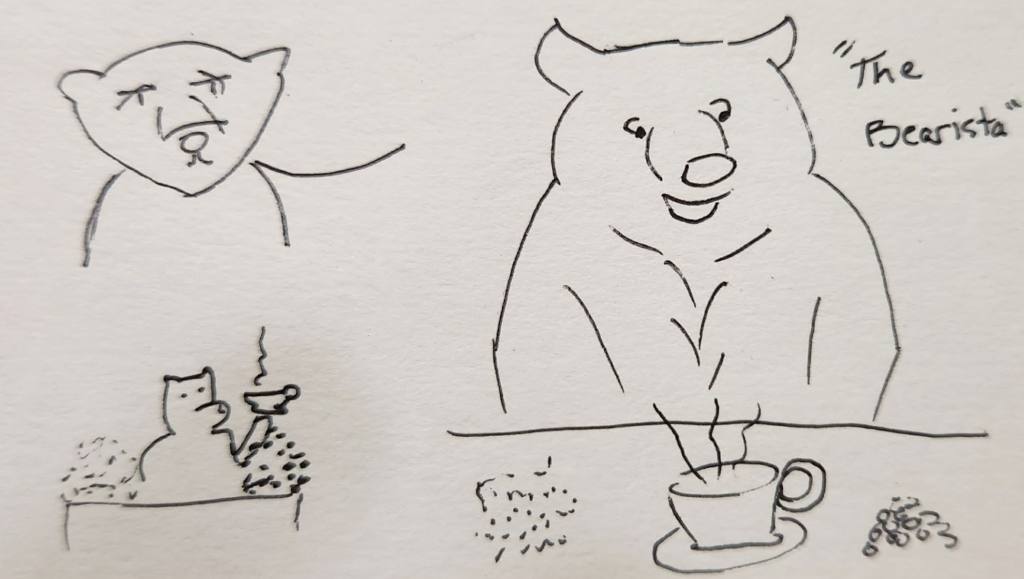
It me took about 10 minutes, but this one has a little bit of drama in it. He’s happy! There is a story happening, a cohesive style, and I even experienced a touch of joy myself while creating it. I had never intended for the pun – I was looking at coffee grinders earlier today and I know from camping experience that bears are attracted to the smell of coffee. But when I started to draw it out, that wordplay just clicked. Serendipity! By choosing to create instead of delegate I uncovered a little bit of my own personal aesthetic and I learned something about myself.
There is a theory that it takes 10,000 hours to achieve excellence in a skill. If I continued drawing my goofy ideas, I would keep discovering things about myself and my abilities that I would have never known. I don’t think those 10,000 hours represent linear progress, I think it represents the importance of developing an intuition for your work and your identity. If you leverage AI to get to that level of mastery artificially, your output will be missing the authentic touches of yourself that makes creating special.
When you’re logging countless hours driving around your hometown you aren’t getting much better at driving, but you are cultivating your subconscious awareness. You’re getting curious about the places that you haven’t been to, and developing an appreciation of your favorites. These are the feelings that make home feel like home. Shortcutting “the grind” shorts you of the complete experience.
Foundational Skills
I’m a few thousand hours shy of world-class, but I have spent a lot of time making pizzas. I started hosting pizza parties in college and continued to slowly refine my dough and sauce recipes over the years into something I’m proud of. I’ve hit a level where I can follow my procedure and be confident that I’m going to serve a delicious pizza that will impress my guests. It took hundreds of mediocre pizzas to get to that point, but the lessons that I learned along the way are invaluable.
If I handed that procedure to someone else, you wouldn’t get the same output. There is a lot of skill in kneading dough that can’t be conveyed with words. Practice lets us develop reflexes, comfortability, and an intuition that can’t be developed any other way.
One fateful night, I was up late making a pizza dough for a party that week. It was after midnight and I was exhausted, but I weighted and mixed like usual. As I kneaded the dough, I started to feel that something was different. The texture was slightly looser than usual, and the dough was tearing instead of stretching. Visually I noticed that there was some pilling instead of a smooth surface around the dough. Immediately I knew that something was wrong, and with my years of experience, I intuited that I had forgotten to add the vital wheat gluten. Only ten grams of powder, less than one percent of the total dough, but discernable only to someone who has invested time in the craft. Having that kind of intuition is a gift, and it’s something that AI could not generate on your behalf.
AI works wonderfully as a tool to augment your talents, where you can discern what is good and bad with your intuition. Just be careful of building up a house on sand in lieu of stone.
Leave a Reply