What are the odds?
As a kid I was terrified by an episode of The Simpsons where Homer is served a fugu fish, whose lethal toxins need to be expertly removed before it can be eaten. The chef gets distracted, Homer is served the wrong part of the fish, and he spends rest of the episode anxious about death. I was shocked to discover that the fish is real and people actually have died after eating it. I couldn’t fathom it – why take the risk of eating a meal that might kill you? Could anything be that delicious? Personally, I don’t want any of my meals to come with the chance of death. To others, that can be negotiated.
In life there are all sorts of situations where we calculate our own risk-reward ratios. When I consider a tough decision and weigh outcomes versus likelihoods, I ask myself: “Do I want to roll these dice?”
Facing The Outcomes
Living with roommates is a gamble. They could be rude or unhygienic. Every day there’s a chance that the sink is full of dishes or the table is covered in junk. But roommates could introduce you to new hobbies and become lifelong friends. It takes some serious weighing of your wants and needs to determine what you’re willing to lose to gain.
Imagine what the house is like whenever you come home. If we were to map out every night of the week as the face of a die, it might look something like this:
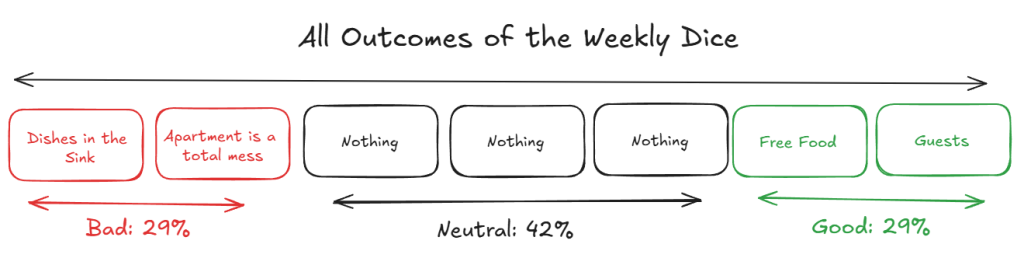
There is a large range of possibilities here, and each of the 5 distinct situations comes with different feelings. Messes can be stressful, but visitors can be fun. There is a high variance here, however you categorize things, and the mental load of having so many possibilities can be a source of stress.
The most likely individual outcome, the expected value, is nothing. But the likelihood of not nothing, the other outcomes added together, is higher. So although we might expect nothing to be happening on any given day, we can’t depend on that being the case. It’s our expected value, but it’s not a consistent value.
Fortunately, we can make tweaks to our situations – change a face here and there on the dice that we cast. What outcomes could we eliminate?
Let’s make a new rule: “No parties”. This stops there from being any total messes, but you’re not getting any more free food:
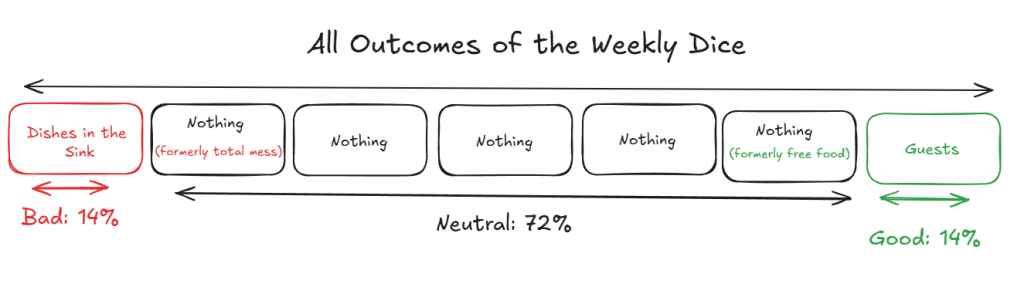
If we crunch a few numbers, we can see that the probability of a bad situation has gone down from 29% to 14%. Our expected value has become more consistent. Since a neutral-or-better result has become a more reliable, our quality of life has increased. A smaller range of outcomes means we can focus on the ones that still occur and stop dreading those that won’t.
Now that we’ve created this dice model, let’s see what happens when there are four people living in this house by rolling four of those dice at once:
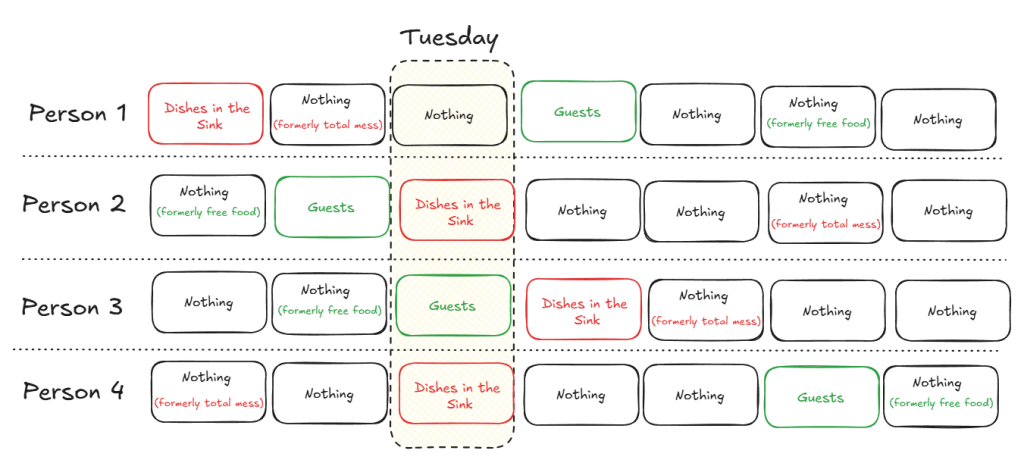
Once the overlaps start to compound, whether or not this chaos matrix is worthwhile depends on the individual.
Dice Are Molded
Have you ever seen a shopping app break? Maybe you try to remove a shirt from your cart but the item is still sorta there? It’s still in the cart visually but the subtotal went down. It’s probably fine, right? What’s that worst that could happen?
You place the order and – behold! – in the morning, it’s on your doorstep. You get charged for it, but since it’s not listed in the invoice you’re unable to return it.
Put yourself on the other side of this issue – you’re a developer making changes to how carts are saved in this app. You see a weird issue – once – where an item doesn’t get deleted from a cart. You investigate it, but you can’t reproduce it. Should you release this update?
What does that dice look like? Do you place orders on a buggy app? Do you ignore the weirdness you saw when you were testing? You can’t confidently roll the dice when every face is a question mark.
If a developer’s code works 75% of the time, then we have a 1-in-4 chance of releasing a bug. By the time we have four developers the expected value of a bug becomes likely.
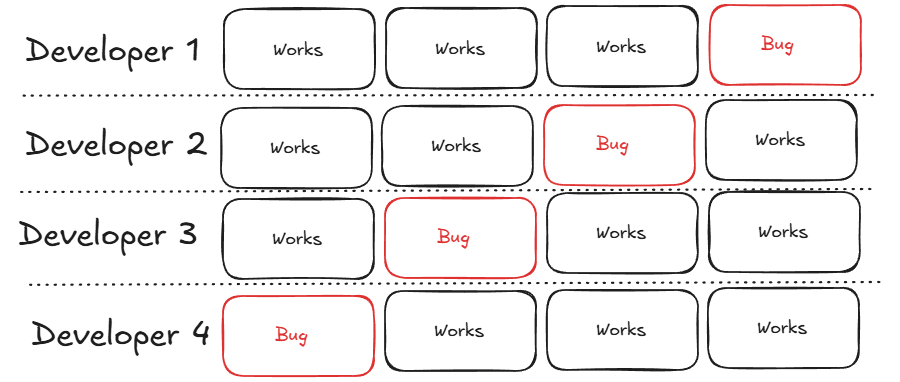
Sure, probability means that we could have three days with no bugs and one day with all bugs. But since we can identify that bugs are a consistent outcome, it becomes worthwhile to have a tester that will identify and prevent them. They reduce the range of bugs on our dice.
Each scenario we investigate reveals a face on the die. In this way, testing inserts success faces onto the die. Once testing increases the success rate up to 90%, the matrix has an entirely different look:
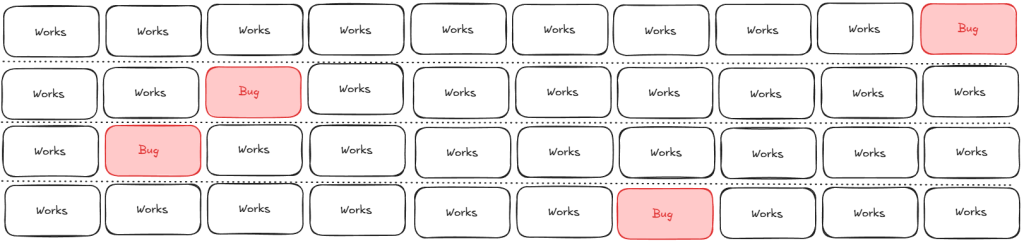
We’re still expecting a bug 40% of the time, but our tests ensure that the critical behavior is protected, and these bug faces actually represent small issues.
Is the risk of small issues worth releasing new code?
Is the risk of not releasing code worth having no issues?
Shooting Blanks
Everyone would roll a die where every face is a winner. But reality is that everything comes with risks and rewards, and we balance that at the intersection of our knowledge, wants, and needs. We can transform our dice into something more favorable, but we may end up carving out the reward in our attempt to reduce the risk.
Consider your career: every day you roll the dice with your job. There is a chance that you lose your job, and a chance that you get a raise. If you work hard and shape that die into one with more faces for career progression, then there is such low risk that you’re safe to keep rolling it as long as you like. Eventually, you’ll get that promotion.
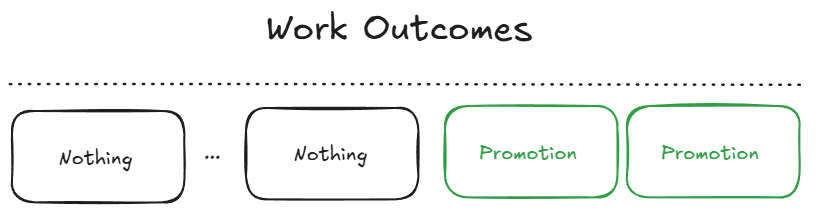
Financial troubles can raise the chance of you getting laid off. Every roll comes with heightened anxiety that you might lose your die entirely. If no one is getting promotions, is that die worth rolling every day?
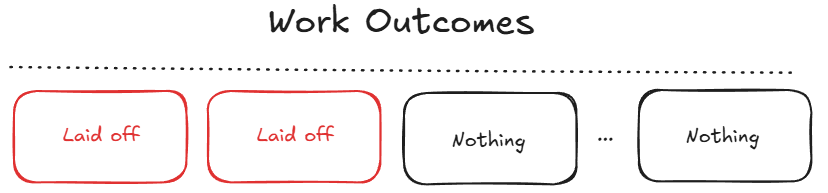
If you’re lucky enough to avoid rolling red until the company’s finances stabilize, the die changes again. If you’re the last person left in your department, there is no chance you lose your job. However, there is no chance you’re getting a promotion. The die is low-risk and low-reward.
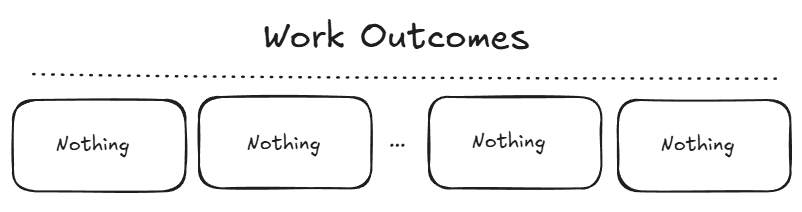
There are a lot of jobs out there, and each die has a different risk-to-reward ratio. Our careers only last so long, and our lives only last so long, and each day comes with the opportunity cost of the die that you aren’t rolling.
It’s important to be mindful of what our dice used to look like and how they could look in the future. Yours might look just like this. If you want to change those odds you’ll need to cast aside that old, worn die and pick up a new, rough rock to polish into a diamond.
Do you eat a fish that might kill you?
Can you spend the rest of your life wondering how it tastes?
Leave a Reply